

Disconnected systems
Equipment, people, and workflows often operate independently without a shared understanding of facility state.
NXTektal helps physical facilities understand their environment, make operational decisions, and coordinate robots, equipment, and people — starting with closed-loop operations at driving ranges.
Based on NXTektal customer discovery to date.
Facilities operate through disconnected equipment, manual decisions, and fixed workflows. The challenge is not only automation — it is understanding the current state of the environment, deciding what should happen next, and continuously improving operations over time.
Equipment, people, and workflows often operate independently without a shared understanding of facility state.
Operators often respond after problems appear instead of receiving proactive recommendations.
Facilities repeat decisions without systematically learning from past outcomes.
Autonomous facilities require more than machines. They require a system that understands state, makes decisions, learns from outcomes, and coordinates execution.
Ball operations are repetitive, labor-intensive, and directly tied to customer experience—which makes the driving range a practical place to prove reliable autonomy and measurable operating economics before expanding across the facility.
At one driving range, collection runs can occur roughly every two hours, take more than an hour, and still require manual unloading and transfer afterward.
Collection, unloading, and transfer happen throughout the operating day.
When the ball supply breaks, customers notice immediately.
Labor hours, run frequency, interventions, downtime, and ball availability can all be tracked.
The intelligence layer monitors ball availability, decides when collection is worth running, and verifies the result — the Autonomous Collection System executes: collecting, returning to the handoff point, and transferring balls into the range’s existing processing equipment.
Ball availability and demand are tracked across the range.

The Range Operations Agent decides when collection is worth running.

A mission is issued to the collection system.

The robot sweeps priority zones and fills its hopper.

It navigates back to the handoff point.

Balls transfer into the modular handoff unit.

The facility’s existing equipment processes and returns balls to players.

The workflow is confirmed complete and logged for review.

Monitors demand, equipment state, and mission status, then determines when collection is needed.
Collects balls, navigates the range, returns to the handoff point, and recharges between missions.
Connects collection with the facility’s washer and dispenser infrastructure to reduce routine manual transfer.
NXTektal is being designed around common wash-and-dispense configurations rather than requiring a facility to replace its entire system. Site-specific calibration and modular interfaces connect the workflow where needed.
Robot docks at the handoff point
Balls transfer into existing washing equipment
Transfer verified — workflow logged
Compatibility and final integration are assessed site by site.
NXTektal’s Range Operations Simulator replays demand changes, robot states, dispatch decisions, handoff activity, and equipment constraints before an operating policy reaches a pilot site.

Each run records service availability, throughput, stockouts, interventions, energy use, robot utilization, and estimated operating cost, allowing policies and failure responses to be compared under the same scenario.
Model demand, robot availability, equipment delays, and failure conditions.
Measure availability, throughput, stockouts, interventions, energy, and utilization.
Surface policy changes and operating recommendations for human review.
Coordinate approved tasks across robots, equipment, and workflow agents.
Compare expected and observed outcomes to inform the next recommendation.
Simulation informs operating decisions. Field performance is validated separately during pilot deployment.
NXTektal is being designed to understand facility state, decide what should happen next, remember what worked, and coordinate autonomous execution. The facility manager remains in control of goals, policies, and approvals.
The facility as it actually is — machines, terrain, weather, demand, and the people working in it.
A current understanding of inventory, equipment, demand, terrain, resources, and constraints.
Determines priorities, risks, recommended actions, and resource allocation — the facility manager approves.
State, decision, human action, and outcome feed improved future decisions — each facility develops its own operational knowledge over time.
A living representation of terrain, infrastructure, equipment, operational zones, workflows, constraints, and the relationships between systems — not only visualization, but the operational state of the physical environment.
Robots, sensors, connected equipment, and human workflows carry out approved work and report back.
Operational Memory closes the loop: state, decision, human action, and outcome feed back into the next recommendation — so each facility gets operationally smarter over time.
Observed demand peaked later than the current schedule on 6 of the last 7 days.
Recommended collection windows updated from observed demand.
Interruption detected and routed for review with mission context attached.
Dispenser supply holding through the afternoon peak.
Returning to handoff point after priority sweep.
Next mission window aligned with demand forecast.
Manual intervention recorded and assigned for review.
Modules marked CONCEPT illustrate the platform direction and are not current functionality.
Use your own labor, collection frequency, run time, and equipment costs to estimate the direct operating cost of today’s workflow.
Complete the highlighted fields to calculate.
Preliminary estimate based on the information and assumptions shown. It is not a quote, guarantee, or final operational assessment.
Illustrative managed golf-facility plan — not a specific customer facility.
Every managed outdoor environment has physical state, operational constraints, resources, workflows, and decisions. The tasks change — the intelligence problem does not. NXTektal applies the same intelligence layer across different facilities.
LONG-TERM PLATFORM DIRECTION
We are speaking with facilities that want to evaluate equipment integration, workflow reliability, labor reduction, and ball availability in a real operating environment.
Understand the current collection, unloading, washing, and dispensing workflow.
Configure collection, handoff, equipment interfaces, and operating rules.
Measure availability, labor requirements, interventions, reliability, and economics.

Co-Founder & Chief Executive Officer
Matthew is a UC Berkeley graduate who leads company strategy, customer development, fundraising, and North American partnerships.
matthew@nxtektal.com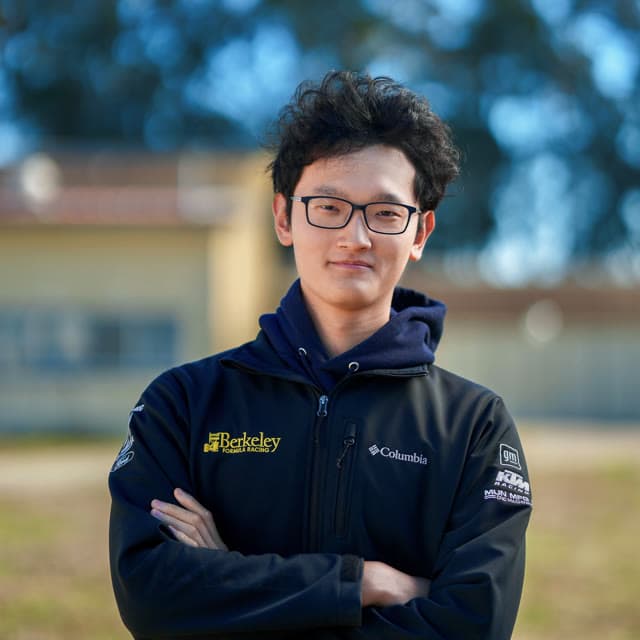
Co-Founder & Chief Technology Officer
Steven studies Physics and Economics at UC Berkeley and has hands-on experience in Formula SAE and competitive robotics. He leads robotics engineering, system architecture, and product development.
steven@nxtektal.com
Co-Founder & Chief Operating Officer
Jason is an engineering student at the University of British Columbia with access to a multi-factory manufacturing network, established component and electronics suppliers, and export channels serving Europe and the United States. At NXTektal, he leads manufacturing, supply chain, production, and China operations.
jasonchen@nxtektal.comWe are looking for pilot facilities, equipment partners, and collaborators who want to help validate the first closed-loop workflow.